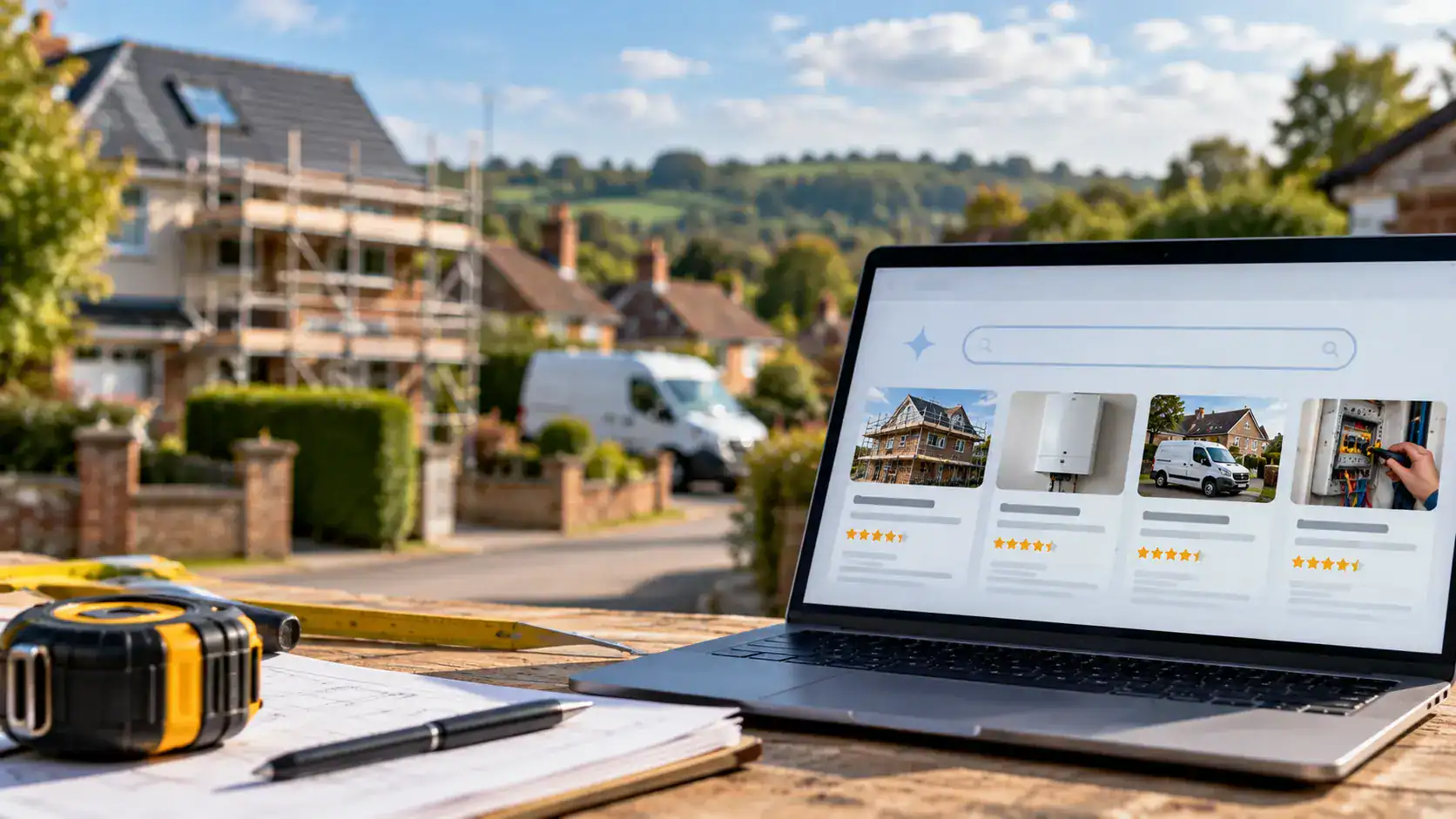
Search used to work one way: someone typed a query, Google returned a list, and your job was to appear near the top. That's still happening, but it's no longer the whole picture. AI-powered tools now answer questions directly, naming specific businesses in the process. If your business isn't structured to be cited, it won't be.
Key Takeaways
- Answer Engine Optimisation (AEO) is the practice of structuring your online presence so AI tools like Google's AI Overviews, ChatGPT, and Gemini cite your business when someone asks a question your service answers.
- AEO builds on Local SEO rather than replacing it. Strong foundations in both are what get you named, not just listed.
- The signals AI tools use to decide who to cite include consistency of business information, clarity of service areas, structured content, and review volume.
- Trades businesses that have already built some visibility are better placed to benefit from AEO than those starting from nothing.
- Local Heroes Agency's complete AI optimisation system starts from £1,000 per month, with no long-term contracts and a cancel-anytime policy.
Why Are Tradesmen Suddenly Hearing About This?
The short answer: search behaviour is changing in a way that makes existing visibility less reliable than it used to be.
When someone searches for a plumber or roofer today, they don't always see ten blue links. Increasingly, they see a generated answer at the top of the page, sometimes with a business name included, sometimes without. That generated answer comes from an AI that has already decided which businesses are worth citing based on the information available to it.
The same process happens in ChatGPT. Someone asks "who's a good electrician in Buckinghamshire?" and the AI generates a response. That response is built from structured data, review signals, content it has already processed, and the consistency of the information it has found about local businesses. If your business isn't structured to be read and trusted by these systems, it won't appear in those answers regardless of how good your actual work is.
The businesses showing up in AI answers aren't necessarily the best tradesmen in the area. They're the ones whose online presence is structured in a way AI can read, trust, and repeat.
How Is AEO Different From the SEO You're Already Doing?
Traditional Local SEO is about ranking in a list of results. AEO is about being cited in a direct answer. Those sound similar, but the mechanics are different.
With Local SEO, Google evaluates your page against others and places you in a ranked list. With AEO, an AI evaluates whether your content is clear, consistent, and authoritative enough to include in a synthesised answer it's generating on the fly. It's not picking from a ranked list. It's constructing a response and deciding whether your business deserves a mention within it.
The overlap matters. A strong foundation in local SEO for trades businesses is what AEO builds on top of. A well-maintained Google Business Profile is one of the strongest trust signals both systems read. But AEO adds a specific layer of content structure and citation-readiness that conventional SEO work doesn't address on its own.
Local SEO gets you in the room. AEO gets you named.
What Does an AI Actually Look for When Deciding Who to Cite?
This is where the practical difference lives. AI tools don't rank pages. They synthesise answers from sources they've determined are trustworthy and clear. Several signals drive that determination.
Consistency across the web.
Your business name, address, phone number, and service areas need to say the same thing everywhere they appear. When that information is inconsistent across directories, review platforms, and your own website, it creates conflicting data that AI tools treat as a reason to doubt. This is why citation management matters far more than most trades businesses realise. It's not tidying up. It's a direct input into whether an AI trusts your business enough to mention it.
Clarity of service and location.
A homepage that says "quality work at competitive prices" tells an AI almost nothing. A page that clearly states you carry out boiler installation and repair across Guildford, Godalming, and Farnham gives it something specific to work with when someone asks a relevant question in those areas.
Structured content that answers real questions.
AI Overviews and similar features pull from pages that directly answer what users are asking. If your website doesn't contain those answers in a readable, well-organised format, it's unlikely to be cited regardless of how your core service pages are performing in traditional search.
Review volume and recency.
A business with a handful of reviews from several years ago reads differently to an AI than one with a consistent, growing stream of detailed, recent reviews. Building a steady flow of Google reviews isn't only about reassuring potential customers. It's a live trust signal that feeds into citation decisions.
What Does This Look Like for a Roofer in Surrey or a Plumber in Buckinghamshire?
Consider a typical scenario. A roofing contractor has a functional website, a Google Business Profile, and ranks reasonably well for a couple of local search terms. When someone types "roofer in Reigate" into Google, they appear in the local pack.
But when that same person asks Google's AI Overview "who's a reliable roofer near Reigate?", a competitor from the next town gets cited instead. Not because that competitor does better work. Because their website has clearly structured service area pages, their FAQ content directly answers questions homeowners ask before booking, and their business information is consistent across 40-plus directories.
The first business is doing Local SEO. The second is doing AEO. The gap between them isn't about technical complexity. It's about structure and intentionality.
This distinction shows up in real results. Tony from Keystone Comfort Solutions ranks at the top of Google for boiler installation and repair searches. The Chimney Experts generates over 25 leads every month from local search. In both cases, the work isn't complicated to describe. It's consistent, structured visibility built to be found and cited across every surface where potential customers are looking.
If you're running SEO for your roofing business or as an electrician and leads have plateaued despite reasonable rankings, the likely explanation is that you've optimised for how search used to work. AEO is what closes the gap between where you are now and where customers are increasingly looking.
Why the Most Confident Businesses Are Often the Least Prepared
Here's a point worth sitting with. The trades businesses most certain their SEO is "sorted" are often the ones least ready for AI search.
They've got rankings. They've got a Google Business Profile. They're getting some leads. Everything looks fine on the surface.
What they haven't got is content structured for extraction by an AI. They haven't had their citation profile audited for consistency. They don't have service area pages that tell an AI tool exactly where they work and what they do there. Their website was built to look professional and convert clicks, not to be cited in a generated answer.
A report that shows impressions going up without a corresponding increase in enquiries is often the first sign this gap exists. Understanding what your local SEO report should actually tell you is a useful place to start if you're not sure whether your current data is telling you the real story.
How Does AEO Stack Up Against Other Approaches?
| Approach | What it delivers | What it doesn't deliver | Risk if you wait |
|---|---|---|---|
| AEO with Local Heroes Agency | Citation-ready presence across Google, AI Overviews, ChatGPT, and Gemini. Builds compound visibility over time | Not immediate. Takes months to build, not weeks | Competitors build authority you'll need to overcome later |
| Local SEO alone (no AEO layer) | Traditional rankings and map pack visibility | No optimisation for AI citation surfaces | Works now, but gap widens as AI search grows |
| Doing nothing or going it alone | Low cost in the short term | No structured progress, no accountability, no citation signals being built | Every month a competitor gets cited instead of you is a lead that didn't ring your number |
| Using an unspecialised provider | General digital marketing activity | No focus on the specific signals that drive AI citation or local pack performance | Budget spent without the underlying structure that makes AI visibility possible |
Is AEO Worth It If You're Already Getting Leads?
Yes. Specifically because you're already getting leads.
If your business is generating enquiries through referrals, existing rankings, or other channels, you've already shown there's genuine demand for what you do. AEO doesn't create demand. It captures the demand that's already there but currently going elsewhere.
Businesses that wait until leads slow down to think about AEO end up having to rebuild from a weaker position. Businesses that layer AEO onto a working foundation compound their visibility while competitors are still figuring out what changed.
Comparing AEO honestly against other growth options shows that the cost of inaction isn't hypothetical. It's the steady accumulation of leads that went to someone else because they were structured to be cited and you weren't.
When AEO Isn't the Right Starting Point
AEO isn't where to begin if your business has no web presence, no Google Business Profile, and no reviews. The foundation has to come first: a conversion-optimised website built to be crawled and cited, a properly claimed and verified GBP, and a citation profile that's been set up correctly from the start.
AEO also won't rescue a situation where the underlying business has problems that marketing can't solve. If reviews are consistently negative, service areas are unclear, or the core offer is inconsistent, structuring that content more clearly only amplifies what's already there.
And if you need results in the next four weeks, this isn't that. AEO is a compounding investment. The businesses that see consistent lead flow from AI search built that position over months of structured, methodical work.
FAQ
How long does AEO take to produce results?
The timeline depends on how much foundational work is needed before the AEO layer can be built on top of it. Businesses with an established Google Business Profile, consistent citations, and an existing website that can be restructured tend to see movement faster than those starting from scratch. Expecting measurable changes within three to six months of structured work is realistic. Expecting results in the first month is not.
Do I need a new website to do AEO properly?
Not necessarily. In many cases, an existing website can be restructured and extended with the right content without a full rebuild. What matters is whether the site can accommodate clearly written service area pages, FAQ content, and schema markup. If the platform restricts those changes, a rebuild is usually the more efficient path in the long run rather than working around the limitations.
Does AEO work across ChatGPT and other AI tools, or just Google?
AEO covers all AI-powered answer surfaces including Google's AI Overviews, ChatGPT, Gemini, and others that synthesise answers from web content. The signals that make a business citable, such as consistency, clarity, and structured content, are the same across all of them. You're not optimising for one platform specifically. You're building the kind of presence that AI tools in general know how to read and trust.
What's the difference between AEO and just optimising my Google Business Profile?
A well-maintained Google Business Profile is one important input into AEO, but it's not the whole system. AEO also covers the content structure of your website, the consistency of your citations across directories, your review signals, and how clearly your services and service areas are communicated across every surface an AI might read. Local Heroes Agency includes GBP management within their AEO work, but it sits alongside several other components rather than standing alone.
Can I do AEO myself?
Some elements, such as writing clearer service area pages or requesting more reviews consistently, are things you can work on independently. The parts that require more technical knowledge, including schema markup, citation auditing, and structured content optimisation, are harder to do well without experience in this area. The risk of doing it incorrectly isn't just wasted time. Inconsistent citations or poorly structured content can actively work against you in AI citation decisions, because the conflicting signals give AI tools reason to distrust what they find.
How does AEO fit alongside Google Ads?
They serve different purposes and can work alongside each other. Google Ads buys visibility at the moment someone searches. AEO builds organic authority that earns citation over time. If your Google Ads are running but the enquiries aren't coming through as expected, the underlying issue is often that the landing experience doesn't convert well. That's a problem conversion rate optimisation and AEO both help address, rather than something more ad spend will solve.
What does the Local Heroes Agency actually do each month?
Each month covers content optimisation, citation monitoring, GBP management, review strategy, and a report tracking keyword rankings, website traffic, and conversions. The work is structured around building visibility across both traditional search and AI-powered answer surfaces. There are no long-term contracts. You can cancel at any time, which means the work has to keep earning its place month after month.
If you're a trade business in Surrey or Buckinghamshire and you've been assuming your current marketing is keeping pace with how search is actually changing, it's worth taking an honest look at that assumption. Most businesses haven't made the shift yet. That's not a criticism. It's just where the market is right now, and it's exactly the kind of gap that compounds over time.
Local Heroes Agency works specifically with home service businesses to close that gap. Get in touch to start an honest conversation about where your visibility stands and what it would take to make it work harder.