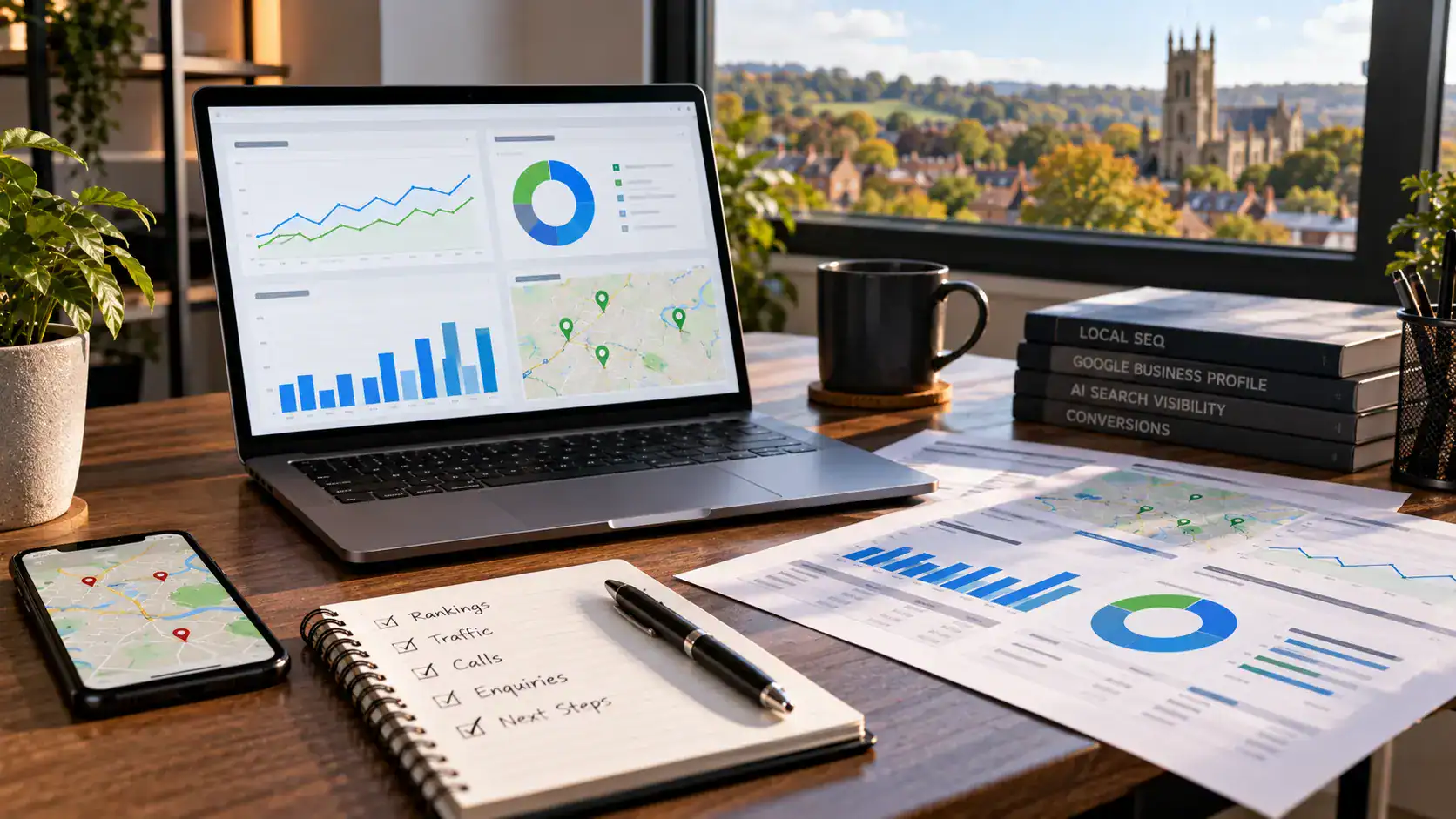
If you're paying a local AEO agency every month and genuinely can't tell whether the campaign is moving forward, that's not a patience problem. It's a reporting problem. A well-structured monthly report should tell you which keywords moved, what drove the change, whether AI search tools are surfacing your business, and exactly what the agency is doing next.
Key Takeaways
- Monthly reporting is the minimum cadence for catching algorithm shifts before they cost you enquiries
- A report showing traffic numbers without ranking context is decorative, not diagnostic
- AI search visibility across ChatGPT, Gemini, and Google AI Overviews needs its own tracking layer, separate from traditional rank tracking
- Quarterly or ad-hoc updates create compounding blind spots in competitive local markets
- The value of any report is entirely downstream of what the agency does with it
Why Does Reporting Feel So Useless So Often?
Most agencies do produce reports. The problem is that most reports are written to demonstrate activity rather than explain outcomes.
There's a structural reason for this. Agencies are incentivised to show they've been busy. So you receive a PDF with a traffic graph, a keyword list, and a paragraph about "continued optimisation." None of it tells you whether your phone is going to ring more next month.
A report that can't answer "what changed and why" isn't a report. It's a receipt.
The deeper issue is that most reporting templates were built for large e-commerce businesses tracking thousands of keywords across national campaigns. When that same template gets applied to a heating engineer in Buckinghamshire or a roofer in Surrey, the signal-to-noise ratio collapses. You're looking at metrics that don't map to your actual problem, which is this: are the right people finding you when they need what you do?
What Should a Monthly Report Actually Contain?
A monthly report from a local AEO agency is a structured document tracking the specific signals that determine whether your business gets found, called, and chosen. Everything else is optional.
The core components that matter for a trades business:
- Local keyword rankings for your primary service and location combinations
- Google Business Profile metrics covering views, direction requests, calls, and website clicks
- Website traffic broken down by source, with particular attention to organic and Maps traffic
- Conversion data including enquiry forms submitted, calls, and quote requests
- AI search visibility: whether your business is being surfaced in ChatGPT, Gemini, or Google AI Overviews for relevant queries
That final item is the one most agencies skip entirely. AI-generated answers are already directing enquiries toward the trades businesses that appear in them. If your agency isn't tracking that layer, you have no visibility into a channel that's actively reshaping where searches end up.
Local Heroes Agency provides detailed monthly reports tracking keyword rankings, website traffic, and conversions as a standard part of every package. That's not a premium add-on. It's the baseline for knowing whether anything is actually working.
What Does Good Commentary Look Like Inside a Report?
The data in a report is only half of it. The commentary is where the agency earns its fee.
Good commentary explains what the agency is doing in response to what they're seeing. Not "we'll continue to optimise your profile." Something specific: which pages are being adjusted, whether a review acquisition push is planned, and why a particular ranking moved.
Consider a typical situation. A plumber in Surrey has been running an SEO campaign for several months. Their profile views are up, but direction requests are flat. A useful report doesn't just surface that gap. It explains the likely cause, such as the profile drawing impressions from a wider area than the business actually serves, and it outlines the specific fix: tightening the service area definition and reinforcing local signals through structured citations.
That's the kind of commentary that connects data to action. Without it, even accurate numbers become ambiguous, and ambiguity creates doubt about whether the campaign is heading anywhere useful.
Monthly vs. Quarterly vs. Ad-Hoc: Why Cadence Matters
This is where most agencies default to whatever's easiest rather than what actually fits the campaign.
Monthly reporting makes sense when:
- You're in the first twelve months of a new SEO or AEO campaign
- You've recently expanded into a new service area
- You've made significant changes to your website or Google Business Profile
- A competitor has started outranking you and you're actively responding
Quarterly reporting becomes acceptable when:
- Rankings have stabilised and you're in a maintenance phase
- You have a separate real-time dashboard you can check independently
- The campaign is more than eighteen months old with consistent results
Ad-hoc reporting is almost always the wrong choice for trades businesses. Local search rankings shift in response to algorithm updates, competitor activity, and seasonal demand. If reporting only happens when someone remembers to send something, a ranking drop in October can go unnoticed until January. That's three months of missed enquiries that could have been recovered with a single mid-cycle intervention.
Monthly reporting creates a feedback loop. Data reveals a pattern, the pattern points to a lever, the agency pulls that lever, and next month's report shows whether it worked. Break any link in that chain and the report becomes decorative.
Comparing Your Options: Reporting Structures and What Each Gives You
| Approach | What you actually know | Response speed when something drops | AI visibility tracked |
|---|---|---|---|
| Monthly reporting with Local Heroes Agency | Rankings, traffic, conversions, and AI visibility in one view | Within days of the monthly cycle | Yes, as standard |
| Monthly reporting from a generic agency | Usually traffic only, limited GBP data | Slow, often reactive rather than proactive | Rarely |
| Quarterly reviews | What happened three months ago | Too slow to catch algorithm shifts | Almost never |
| Ad-hoc updates | Whatever the agency felt like mentioning | No structure, no consistency | No |
| No formal reporting | Nothing verifiable | You find out when the leads dry up | No |
The pattern is clear. The further you move from structured monthly reporting, the more you're trusting that nothing important has changed. In local search, something important changes on a regular basis.
The Point Most Agencies Won't Make About Their Own Reports
More data in a report doesn't mean better reporting.
A forty-page document with twelve graphs is not more useful than a focused six-page report that explains three things clearly. The instinct to fill a report with metrics is the same instinct that produces useless reports. It looks thorough. It isn't.
What you actually need is a report that tells you whether the campaign is on track, what's being done about anything that isn't, and what to expect next month. That requires the agency to take a clear position, which is uncomfortable when results are mixed.
This is worth thinking about when you're choosing a digital marketing partner for your trades business. The quality of an agency's reporting template is one of the most reliable signals of how they actually operate day to day. Vague commentary in a report usually reflects vague work behind it.
What Good Reporting Won't Fix on Its Own
Honest answer: monthly reporting isn't a substitute for a website that converts visitors into enquiries. If your site isn't doing that job, better rankings simply send more people to a page that doesn't work. That's a conversion problem that reporting will surface clearly but can't resolve.
Reporting also doesn't suit businesses that aren't prepared to act on what the data shows. A report that gets filed without being read is a cost with no return. The entire value of reporting sits downstream of what you do with it.
Monthly reporting from a local AEO agency works best as part of a complete visibility system: a well-optimised Google Business Profile, a website built to convert, and a consistent approach to building Google reviews. Each of those elements feeds the others. A report that tracks all of them together gives you a real picture of what's driving enquiries and what isn't.
The One Thing Worth Remembering
Reporting isn't admin. It's the only mechanism you have for knowing whether your marketing budget is compounding or quietly evaporating.
If you're running a trades business in Surrey or Buckinghamshire and your current agency can't clearly explain what last month's report means for your enquiry pipeline, that's the problem worth solving first. You can see what realistic SEO results look like for businesses like yours, or request a free visibility audit to find out exactly where you stand right now.
FAQ
How often should I expect to hear from my SEO agency?
Monthly reports are the standard minimum. A good agency will also flag significant changes between reports if something shifts suddenly, such as a ranking drop or a known algorithm update affecting your service area. Waiting thirty days to learn your visibility fell off last week is not acceptable.
What's the difference between a traffic report and a rankings report?
Traffic reports show how many people visited your website. Rankings reports show where your business appears in search results for specific queries. You need both because traffic can stay flat while rankings improve if search volume is low in a given month, or traffic can drop while rankings hold if Google changes how it displays results pages. One without the other gives you half the picture.
Should my Google Business Profile stats be in the same report as my website stats?
Yes. For a trades business, your Google Business Profile often drives more direct enquiries than your website does. Separating the two makes it harder to see the full picture of how people are finding and contacting you, and it's easier to miss a problem hiding in one of the two channels.
What should I do if my monthly report shows rankings have dropped?
Ask your agency specifically which keywords dropped, when they dropped, and what caused it. A credible answer will reference either a known algorithm update, a shift in competitor behaviour, or a specific technical issue on your site or profile. "We're monitoring it" without a diagnosis is not an adequate response.
Do I need AI search visibility tracked separately from regular SEO?
Yes. Traditional rank tracking tools monitor positions in Google's standard organic results. AI Overviews, ChatGPT, and Gemini pull from different signals and surface different businesses. A trades business can rank well in traditional search and be completely absent from AI-generated answers. These are separate visibility layers requiring separate tracking.
How do I know if my agency's report is useful or just decorative?
A useful report answers three questions: what changed this month, why did it change, and what's happening next. If you read the whole thing and still can't answer any of those three, it's decorative.
Is there a minimum contract length for this kind of reporting service?
Local Heroes Agency operates with no long-term contracts and a cancel-anytime policy. Monthly reporting is included as standard across their AEO and SEO packages, starting from £1,000 plus VAT per month for the complete visibility package. There's no lock-in, which means the reporting has to be genuinely useful to keep you around.
About Local Heroes Agency
Local Heroes Agency is a digital marketing consultancy specialising in Local SEO, Answer Engine Optimisation, and web design for home service businesses and trades. They work with owner-operated businesses across Surrey, Buckinghamshire, and the wider South East to improve local search visibility and generate consistent enquiries from Google, Google Maps, and AI-powered search tools.