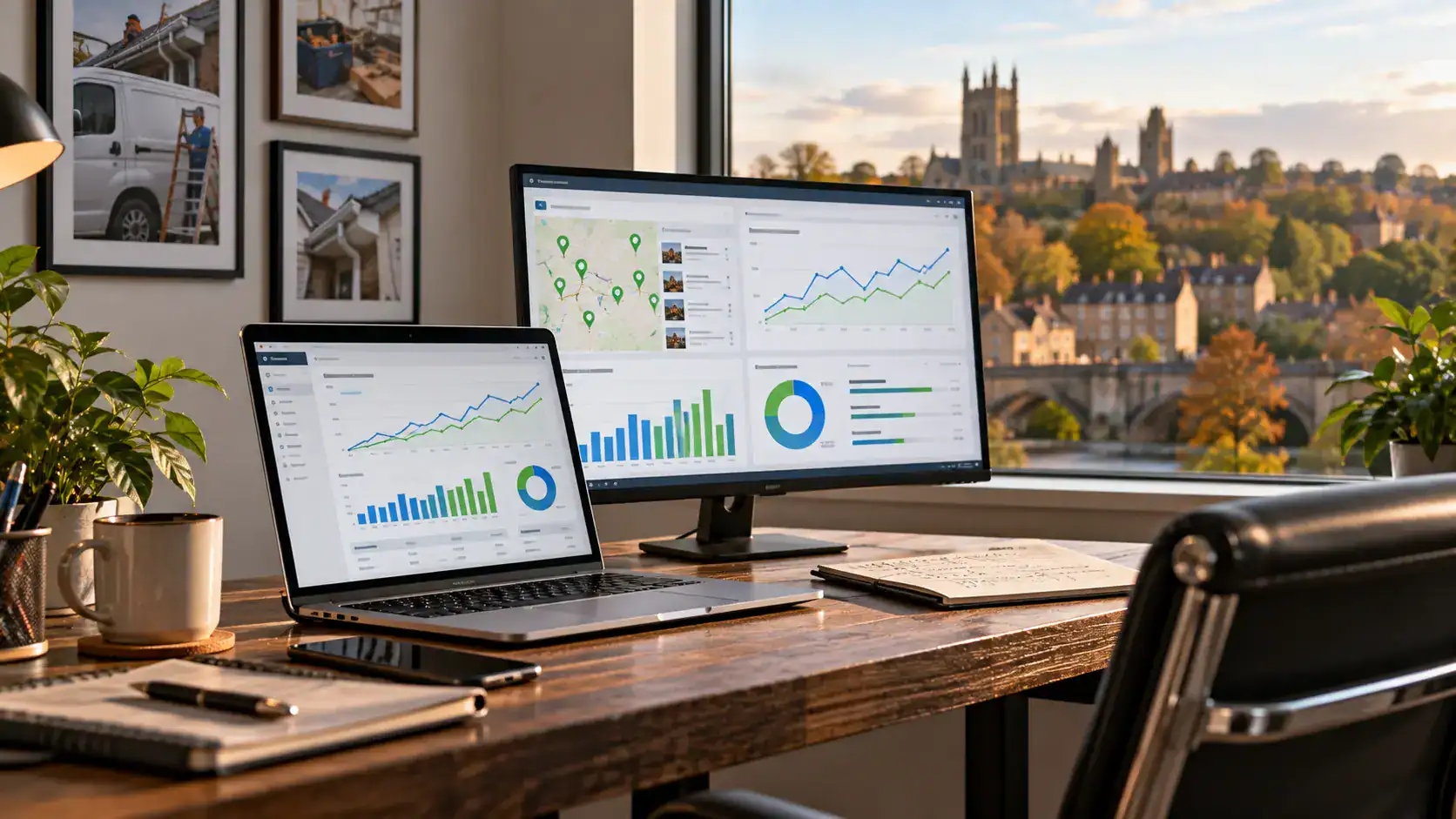
A monthly SEO report should drive decisions, not justify a retainer. Local Heroes Agency structures every report around one question: is your visibility growing in the places that generate actual phone calls and enquiry form submissions? Rankings, traffic, and conversions are tracked together, because a broken link anywhere in that chain stays invisible when they're not.
Key Takeaways
- Rankings, traffic, and conversions are reported as a connected chain, so a problem in any layer surfaces immediately rather than hiding behind aggregate numbers
- Google Business Profile performance and website performance are tracked separately because they fail for different reasons and need different fixes
- Every report includes a forward-looking section covering what changes next month and why
- AI search visibility is tracked directly, so you can see whether your content appears in Google's AI Overviews, ChatGPT, or Gemini
- A free visibility audit establishes your baseline before any reporting cycle begins
What Does a Monthly SEO Report Actually Tell You?
Usually not enough, if it was built to answer the wrong question.
Rankings up. Traffic climbing. Impressions improving. These are outputs. They don't tell you whether a homeowner searching "roof repair near me" in your area called you or the business sitting two positions above you. They don't tell you whether your Google Business Profile appeared in the local pack for that search at all.
That gap between what most agency reports show and what a trades business owner actually needs to know is where most agency relationships quietly unravel.
Consider a typical situation. A trades business has been paying for SEO for several months. The monthly report shows climbing rankings and rising traffic. Enquiries haven't moved. Nobody on either side can identify whether rankings aren't translating to clicks, whether clicks aren't converting, or whether enquiries are arriving through an untracked channel. The report doesn't say. So nothing changes, and nobody knows why.
That's a structural problem, not a data problem. The data exists. The issue is which questions the report was built to answer in the first place.
Why Most Agency Reports Don't Drive Decisions
The root cause isn't laziness. Most reporting frameworks are built to show that work was done, not to guide the next action.
When a report's purpose is proving activity, it lists outputs: posts published, links built, pages optimised. When its purpose is showing visibility growth, it tracks positions and traffic. Neither of those is the same as tracking whether your business is being found by people who are ready to hire someone today.
Understanding how Google search results actually work is a prerequisite for interpreting any report meaningfully. The local pack, organic results, and AI Overviews each behave differently and need different signals to perform well. Collapsing all of them into a single traffic number hides more than it reveals.
A report showing impressions up with no corresponding enquiry data is hiding the real story. Inconsistency creates doubt, and doubt suppresses rankings. If the report can't show you which layer is inconsistent, you can't fix it.
What the Local Heroes Reporting Methodology Actually Covers
The report works across three distinct layers.
The first is local search visibility: where your business appears in Google Maps and the local pack for your core service-area searches. For a plumber covering parts of Surrey or Buckinghamshire, that means tracking positions for searches like "plumber near me" and "emergency plumber" across the specific postcodes they serve. Visibility in the local pack is effectively binary in practice. You're in the top three results, or you're not getting the call.
Reporting a fourth-place position as meaningful progress while the phone stays quiet is exactly how misleading reports erode trust with the businesses that depend on them most.
The second layer is organic and AI search presence. This covers how your website pages rank for informational and commercial searches, and whether your content is being cited in AI-generated answers from tools like Google's AI Overviews, ChatGPT, or Gemini. This is where Answer Engine Optimisation for home service businesses becomes measurable rather than theoretical. If your content is being surfaced in AI answers, the report shows it. If it isn't yet, the report identifies what's creating the gap.
The third layer is conversion performance: what happens after someone lands on your website. A page that ranks well but converts poorly is a leak in the chain. The report flags it explicitly, and that connects directly to conversion rate optimisation for tradesmen carried out alongside visibility tracking.
These three layers only produce useful insight when they're reported together. Track just one or two and you're reading the fuel gauge while ignoring the oil and tyres. You might make it to the next job. You won't know why things went wrong when they eventually do.
What Makes This Different From Reports You've Probably Seen Before
Most reporting is backward-looking. Local Heroes Agency builds a forward-looking section into every report: what's changing next month, why that change is being made, and what outcome it's designed to produce.
This matters because local search isn't static. Google's algorithm updates continuously. AI tools change how they surface local businesses. A competitor can improve their Google Business Profile and take a position you've held for months. Responding to those changes as they happen is part of what the monthly retainer covers, and the report makes that response visible rather than burying it in a vague "ongoing optimisation" line item.
The report also separates GBP performance from website performance. These are managed differently and they fail differently. A Google Business Profile losing local pack visibility typically has a different cause than a website losing organic traffic. Treating them as a single combined number produces the wrong diagnosis and, consequently, the wrong fix.
More data in a report doesn't mean better decisions. A report with dozens of metrics gives you dozens of things to worry about and no clear signal of which one to act on. The Local Heroes report is deliberately focused on the metrics that connect directly to enquiries.
That's a design decision, not a gap in coverage.
Who Gets the Most Value From This Approach
This structure works best for trades businesses generating some enquiries but unable to pinpoint where they're coming from or why some months are stronger than others.
If you've recently taken on staff and need a more predictable pipeline, or you're running Google Ads alongside organic search and can't tell which channel is doing the work, this reporting structure gives you the clarity to make real decisions. The full AEO and SEO visibility package starts at £1,000 plus VAT per month and includes detailed monthly reporting as standard. You can find out how the full methodology works before committing to anything.
It also suits businesses expanding into a new service area. Consider a builder with solid visibility in one part of Surrey who wants to start targeting a neighbouring postcode cluster. Without a structured baseline established from the outset, there's no starting point. That means there's no way to tell whether position movement is happening, stalling, or heading in the wrong direction. A properly structured report creates that baseline from day one, so every change is visible and traceable rather than something you're piecing together from guesswork.
For businesses who want to start with their Google Business Profile before committing to a full package, standalone GBP management for tradespeople starts at £250 plus VAT per month.
Structured Reporting vs. Doing Without It
| Situation | Without structured reporting | With Local Heroes reporting |
|---|---|---|
| Rankings improving but enquiries flat | No way to identify where the chain breaks | Conversion layer reviewed with specific page-level issues identified |
| Expanding into a new service area | Progress invisible until enquiries arrive or they don't | Baseline established from day one so position movement is visible and traceable |
| Running Ads alongside SEO | No reliable way to separate which channel generates contacts | Channel attribution separates organic, GBP, and paid traffic sources clearly |
| Visibility stalling after early gains | No signal on whether AI search is affecting organic results | AI Overviews and answer engine citations tracked directly each month |
| No previous SEO work | No starting point and no way to measure change | Free visibility audit establishes exactly where you stand before any work begins |
What This Reporting Doesn't Do
It doesn't guarantee a specific number of enquiries. That's worth stating plainly.
Visibility and conversion can both be measured and improved. Whether a visitor picks up the phone depends on factors the report can flag but can't control: your pricing, your reviews, and how your website handles the moment someone decides whether to call you or scroll past. The conversion-optimised web design work Local Heroes does addresses part of that, but the report won't claim credit for enquiries it didn't directly influence.
It also doesn't replace a conversation. If something looks unusual or a trend is unclear, you get a straight answer from the people doing the actual work. There are no long-term contracts. If the reporting stops making sense for your business, you can cancel without penalty.
And if you want a live dashboard updating in real time, this isn't that. The monthly report is a structured decision document with a clear forward-looking section, built for a business owner who wants to understand what's happening and what comes next, without needing to interpret a wall of charts.
If you'd like to see how these three layers look for your business specifically, the free visibility audit gives you a baseline reading across local search, Google Maps, and AI-generated results before you commit to anything.
Frequently Asked Questions
How long before the monthly reports start showing meaningful changes?
Local Heroes Agency expects to see measurable improvements in visibility and rankings within the first couple of months. Early reports often look flat because the work is establishing an accurate picture of where you actually stand before any movement becomes visible. The first report is most useful as a reference point, not a performance verdict.
What if I don't understand something in the report?
The report is written for business owners, not marketers. If something isn't clear, you ask and get a direct answer from the people doing the actual work, not an account manager reading from a prepared template.
Does the report cover Google Ads performance?
If Local Heroes Agency is managing your Google Ads alongside your SEO and AEO work, ad performance is included. If you're running Ads separately through another provider, the report covers organic and local visibility but won't have access to your Ads account data.
Can I see what my visibility looks like before committing to anything?
Yes. The free visibility audit gives you a baseline reading across local search, Google Maps, and AI-generated results. That's the starting point for any reporting cycle and it's available before you sign anything.
What happens to my reports if I cancel?
There are no long-term contracts. If you cancel, you keep every report you've received. The data is yours.
Is the reporting different for businesses in Surrey versus Buckinghamshire?
The methodology is the same, but the geographic targets are specific to where you work. A roofer in Surrey and a roofer in Buckinghamshire are tracked against different local pack positions, different competitor sets, and different postcode clusters. The report reflects your actual service area, not a generic regional average.
How is AI search visibility measured?
AI search visibility is tracked by monitoring whether your business or website content appears in AI-generated answers for relevant local queries, across tools including Google's AI Overviews. It's a directional signal rather than a precise ranking position, but it carries real practical weight as more people get answers without clicking through to a website at all. The report shows whether you're present in those answers and which content is being cited.
If your current reporting leaves you guessing whether your marketing is actually working, that's a framing problem, not a data problem. Request the free visibility audit to see where you stand across local search, Google Maps, and AI-generated results before deciding whether this is the right fit.
About the Author: Local Heroes Agency is a digital marketing consultancy specialising in Local SEO, Google Business Profile optimisation, and Answer Engine Optimisation for home service businesses and trades. They work with owner-operated businesses across Surrey, Buckinghamshire, and the wider South East to increase local search visibility, generate consistent enquiries, and build a durable online presence across both traditional and AI-powered search.