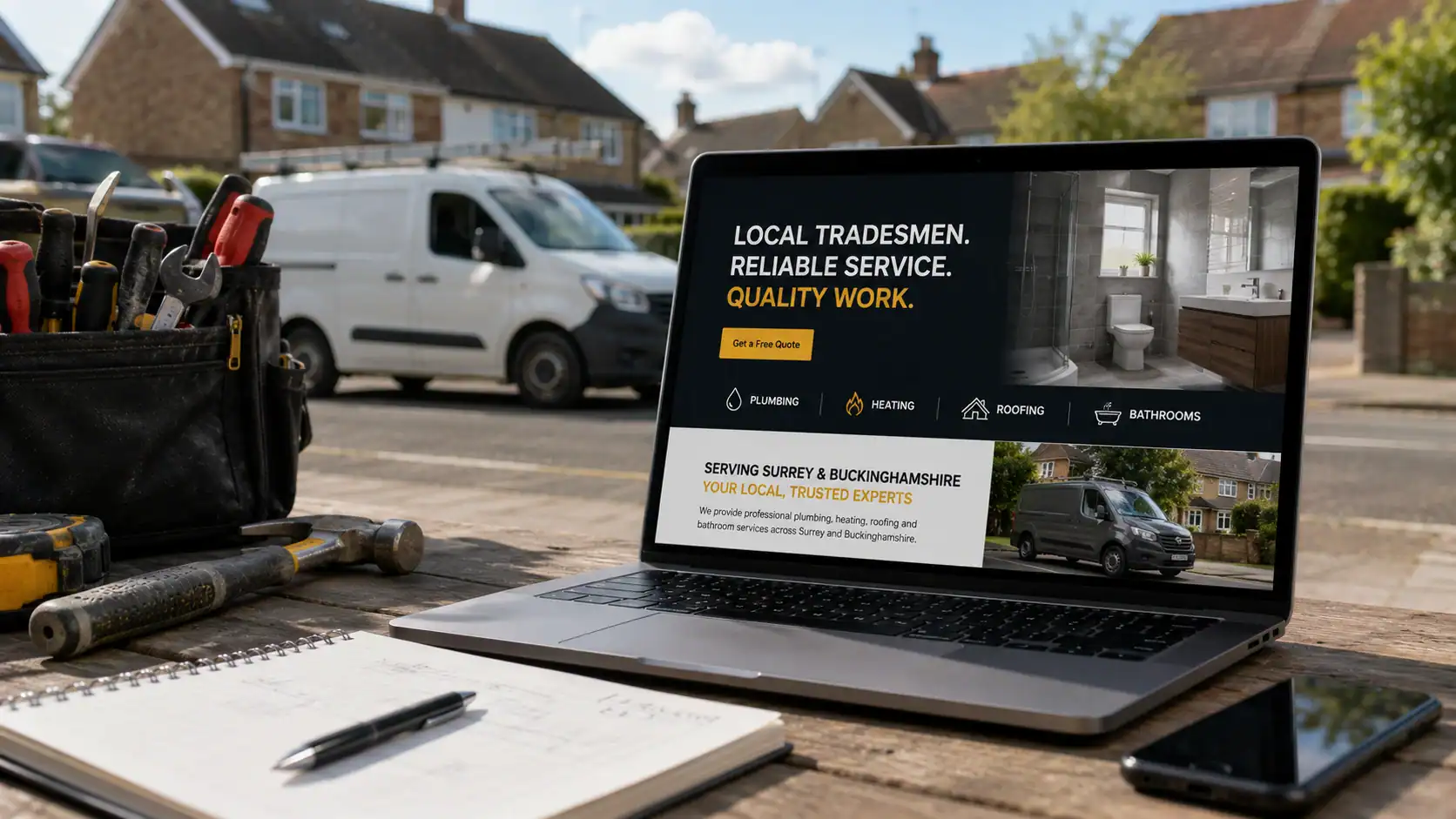
Your website is either generating enquiries or it isn't. For most tradesmen running a site built on Wix, Squarespace, or a similar platform, it's quietly doing the latter. That's not always the platform's fault on its own. The real problem is that website builders were never designed to solve what trades businesses actually need: reliable visibility in local search at the exact moment someone nearby is looking for a plumber, roofer, or heating engineer.
Key Takeaways
- Website builders create an online presence. They don't reliably create a lead-generating one.
- Local search visibility depends on technical structure, content architecture, and off-site signals that most builder platforms restrict or limit significantly.
- A clean-looking site without the right technical foundation will consistently lose enquiries to competitors who've built correctly.
- AI-powered tools like ChatGPT and Google AI Overviews are changing how people find local tradesmen, and website builders give you little control over how you appear in those results.
- Local Heroes Agency builds conversion-optimised websites for trades businesses in Surrey and Buckinghamshire, with no long-term contracts and cancel-anytime terms.
What's the Real Difference Between a Website Builder and a Professionally Built Trade Website?
A website builder lets you publish pages without writing code. That's what it's for.
A professionally built trade website is a lead generation asset. It's structured around the technical requirements that determine whether your business appears when someone searches for "emergency plumber Aylesbury" or "roofer Guildford." Those are two entirely different problems. Treating them as the same is the mistake that costs most tradesmen a year of potential enquiries before they realise what's happening.
Platforms like Wix, Squarespace, and GoDaddy Website Builder are designed for speed and accessibility. You can have something live within a few hours, the templates look presentable, and no technical knowledge is required. For a local café or a freelance photographer, that's often fine. For a trades business that depends on local search to keep the diary full, you're solving the wrong problem.
The gap between a builder platform and a properly configured trade website isn't about aesthetics. It's about architecture. Understanding how Google search results actually work is where most tradesmen first realise why their current site isn't performing the way they expected. Local search visibility depends on technical signals: page speed, structured data markup, crawlability, mobile performance, and how clearly your site tells Google exactly what you do and where you do it. Most website builder platforms restrict access to these signals. Schema markup is either absent or generic. Page speed suffers because these platforms load unnecessary scripts by default. The content structure, the thing that tells Google "this business installs driveways in Epsom and Woking," is left entirely to you to figure out, without guidance, without the right tools, and usually without knowing it matters in the first place.
Why Does a Good-Looking Site Still Fail to Generate Leads?
This is the question most tradesmen don't ask until they've spent money on a site they're proud of and are still waiting for the phone to ring.
A site can look completely professional and still be invisible. Visibility in local search isn't a function of design quality. It's a function of technical structure, content relevance, and how well your off-site signals work together with the site itself.
Consider a typical situation in a competitive local market. A heating engineer builds a clean, well-designed site on a popular builder platform. They list their services, add photos, and put a contact form on the page. It looks professional. But on platforms like this, access to schema markup is typically restricted, control over page speed configuration is limited, and there's no meaningful way to signal service area at a technical level. A site built under those constraints tends to struggle in Google's ranking process because the signals Google relies on are either missing or muddled.
A competitor running a less visually impressive site, built on a properly configured platform with the right technical foundations in place, will often sit higher in the local results simply because Google can read its signals clearly. That difference isn't about the design. It's about the foundation.
Google's ranking process is systematic. It reads technical signals, not aesthetics. A site that sends the right structured signals about location, service type, and relevance will typically outrank a better-looking site that doesn't send those signals. Why your Google Business Profile matters as much as your website covers the off-site side of this equation, because the website and the profile need to work in alignment to have any meaningful effect on local visibility.
What Does Staying on the Wrong Platform Actually Cost You?
The cheapest website option is frequently the most expensive marketing decision you'll make. That's worth sitting with.
A website builder subscription costs a modest monthly fee. That feels low-risk. The cost is visible, the setup is easy, and you're technically ticking the "have a website" box. But the subscription cost is visible in a way that lost work isn't. If your site is generating far fewer enquiries per month than a well-structured site in the same area typically would, you're not saving money. You're absorbing a loss that never appears on any invoice.
That asymmetry is exactly why trades businesses stay on platforms that are quietly costing them far more than the monthly fee suggests. Inaction isn't free. Every month a poorly structured site sits live and invisible is a month your competitors are compounding their advantage in your area.
The conversion-optimised web design service for tradesmen from Local Heroes Agency is built specifically to address the lead generation problem, not just the "have a website" problem. Those aren't the same thing, and treating them as if they are is what keeps too many capable tradesmen off the first page.
What AI Search Changes About This Decision
Most tradesmen haven't asked this question yet. It's becoming one of the most important ones.
Search behaviour is shifting. People are increasingly turning to ChatGPT, Google AI Overviews, and Gemini to find local services. These tools don't simply surface the top-ranked website. They pull from structured, well-organised content that clearly signals expertise, location, and scope of service.
Answer Engine Optimisation, or AEO, is the practice of structuring your website and online presence so that AI-powered tools can accurately identify, extract, and recommend your business when someone asks a relevant question. A website builder gives you no real control over this. The structured data, content architecture, and technical signals that AI tools rely on are either unavailable on those platforms or require workarounds most tradesmen don't know exist and wouldn't have time to implement even if they did.
Local Heroes Agency builds trade websites with AEO incorporated from the start. That's the difference between being found on Google today and being recommended by AI search tools as that channel grows. You can read about the full approach in how Local Heroes Agency's methodology works in practice.
Acting Now vs. Waiting: What Each Path Actually Looks Like
| Factor | Staying on a Website Builder or Doing Nothing | Acting with Local Heroes Agency |
|---|---|---|
| Local search visibility | Limited by platform restrictions on technical SEO | Built on a properly structured, search-optimised foundation |
| Lead volume over time | Flat or declining as competitors invest and compound | Grows as rankings improve and Google Business Profile signals strengthen |
| AI search tools (ChatGPT, Gemini, AI Overviews) | No structured content for AI to extract or recommend | AEO built into site architecture from the start |
| Google Business Profile | Managed inconsistently or not at all | Actively managed and aligned with website signals |
| Monthly cost of staying put | Ongoing lost revenue from enquiries that never arrive | Monthly investment with no long-term contract, cancel anytime |
| Where you end up | Competitors fill the gap you leave open | You become the default choice in your local area |
What Realistic Results Actually Look Like
No guarantees. But here's what properly structured, consistently managed work produces.
Local Heroes Agency has a client ranking number one for "boiler installation Epsom." Another client ranks second in Google for roofing services and receives over 25 leads every month. These results don't come from website builders. They come from properly structured sites, actively managed Google Business Profiles, and consistent SEO work sustained over time.
The mechanism behind those numbers is worth understanding. Rankings improve because the technical foundation sends the right signals, the content is structured correctly for local intent, and the Google Business Profile is managed in a way that stays consistent with the website.
Remove any one of those elements and the results degrade. It's not magic. It's systematic.
What realistic SEO results look like for tradesmen in Surrey and Buckinghamshire gives you an honest picture of timelines before you commit to anything.
One genuine limitation worth naming: in highly competitive areas where several established businesses are already running properly structured sites and active local SEO campaigns, reaching the top three takes longer. The work is the same. The timeline isn't. Local Heroes Agency will tell you what's realistic for your specific area before any money changes hands.
Expect to see early visibility improvements within the first couple of months. The compounding effect, the kind that sustains consistent lead volumes month after month, builds over a longer period. If you need leads this week, Google Ads will get you there faster. If you need a reliable pipeline that doesn't require paying per click indefinitely, getting the website and SEO foundation right is what makes that happen.
Frequently Asked Questions
Can I just add SEO to my existing website builder site?
You can make some surface-level improvements, but most website builder platforms create a ceiling you can't get through from the inside. Full control over schema markup, page speed configuration, and custom URL structures is either restricted or unavailable on those platforms. You end up working against the platform rather than with it. Effort spent optimising on top of a builder is often better invested in rebuilding on a foundation that doesn't fight back.
How long before a professionally built trade website starts generating leads?
Early visibility improvements typically appear within the first couple of months. Meaningful lead volume from organic search usually builds over a longer period after that. The timeline depends on how competitive your local area is and how established your Google Business Profile is when you start. Local Heroes Agency provides detailed monthly reports tracking keyword rankings, website traffic, and conversions so you can see exactly what's moving and when.
Do I need a completely new website or just better SEO on my current one?
It depends on what your current site is built on. If it's on a platform that restricts technical optimisation, a rebuild is almost always more efficient than trying to work around the limitations. If it's on a flexible platform like WordPress with a sound existing structure, optimisation work may be sufficient. Local Heroes Agency will tell you which situation applies before any work begins.
What's the difference between SEO and AEO, and do I need both?
SEO (Search Engine Optimisation) improves your visibility in traditional search results. AEO (Answer Engine Optimisation) structures your content so AI-powered tools like ChatGPT, Gemini, and Google AI Overviews can accurately identify and recommend your business. Both matter because people now find local services across both types of tools. Addressing only one leaves a portion of your potential enquiries unaddressed, and that gap will widen as AI-powered search becomes more common.
Is there a long-term contract?
No long-term contract. You can cancel at any time. Pricing starts from £250 plus VAT per month for Google Business Profile management, rising to £1,000 plus VAT per month for the complete AEO and SEO visibility package.
My competitors have better-looking websites. Is that why they're outranking me?
Almost certainly not. Design quality and search ranking are largely independent of each other. A competitor outranking you is doing so because of better technical structure, more consistent Google Business Profile management, stronger location-specific content, or more authoritative external links pointing to their site. A more polished design won't fix a structural SEO problem. It's one of the more counterintuitive truths in local search, and it catches a lot of tradesmen out.
I get most of my work through word of mouth. Why would I need a website?
Relying on referrals is a fragile position. If a key referrer stops sending work, a platform like Checkatrade adjusts its pricing, or a competitor starts investing heavily in your area, your lead volume can drop quickly with nothing to fall back on. A well-ranked website is a lead source you own and control. The honest tradeoff between doing digital marketing yourself and getting professional help covers the full picture if you want to think it through before making any decision.
The honest position is this: a website builder costs less upfront and consistently delivers less over time. A professionally built, SEO and AEO-optimised trade website costs more and compounds in value every month it runs. If your current site isn't working and you want a straight conversation about what's actually achievable for your business in Surrey or Buckinghamshire, get in touch with the Local Heroes Agency and we'll tell you exactly what we'd do and why.